By Mekonnen Teshome
The “White Mango Scale” plant disease was introduced to Ethiopia in 2001 when an Indian mango cultivar called “Alphonso” imported by an Indian private farming company – Green Focus Ethiopia Limited.
The company introduced the “Alfanso” variety with a view to get a good yield of mango by planting the cultivar in Guto Gida District, Lako Kebele, East Wolega Zone, Oromia Region.
However, the pest infested mango trees in the Sakara farm lands of the Gurafedara district area and other areas and later continued to spread to the western, central and southern regions of the country, causing a major loss of the existing Ethiopian mangoes.
Therefore, at present, mangoes in Ethiopia have failed to bear fruits due to the disease which damages the leaves and fruits of the plant.


Taking this national risk of the mango epidemic, the Adama Science and Technology University (ASTU) and the Bio and Emerging Technology Institute (BETin) have carried out a research project aimed at saving the mango cultivar from extinction.
The research , funded by BETin is being conducted at Mille Chamo Plant Clinic in Gamo zone, Arba Minch Zuria , Southern Regional State.
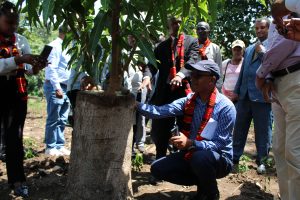
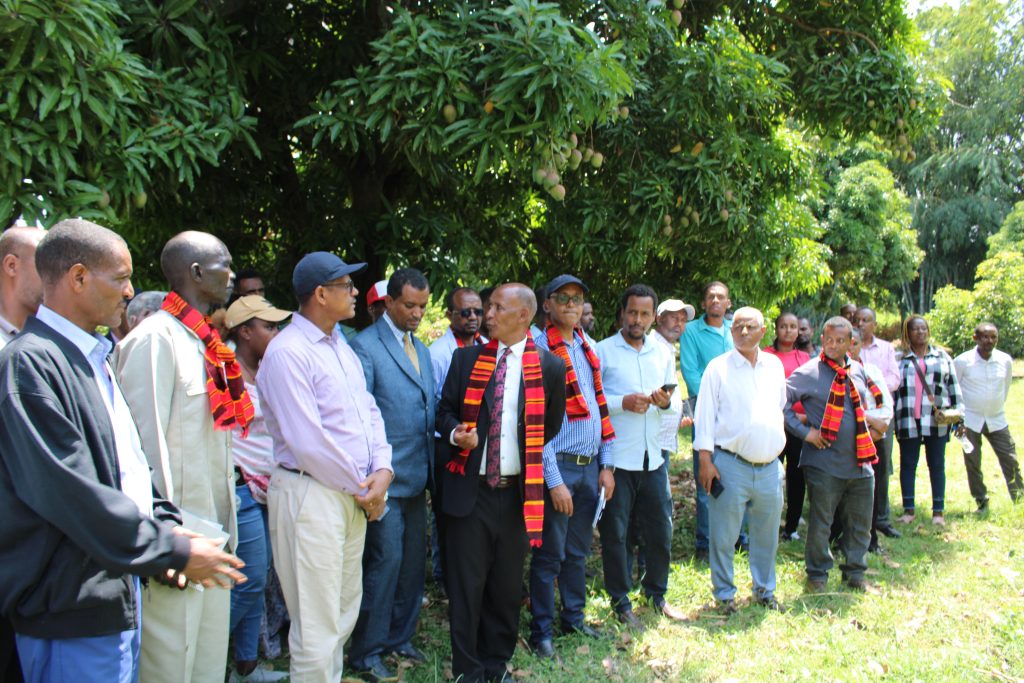
on Saturday, June 29, 2024, experts and leaders from the Bio and Emerging Technology Institute, ASTU and partner organizations visited the research work being carried out at the the spot.
Mr. Belta Begeje , one of the mango grower farmers who live in West Abaya district of the Gamo zone says that his mango productivity and income has decreased significantly due to the dangerous pest and the situation has put a lot of pressure on his livelihood.
Mr. Belta recalled that before the epidemic attacked he used to earn good money selling mangos to the capital Addis Ababa market.
Many other mango producers in the area also face the same challenge because of the disease. Therefore, due to the loss of production they are cutting down their mango plants and replacing them with other crops despite the incomparable and robust income benefits of mango plants against other crops.
He said that he has not yet given up and feel hopeless with the disease infestation and is trying to find a solution from agricultural experts in his district as they promised to get him mango varieties that have the ability to resist the disease.
Director-General of the Bio and Emerging Technology Institute Prof. Kassahun Tesfaye also pointed out that the research was launched to save the mango variety with the financial support of his institute and mainly implemented by ASTU and it has shown promising results in a short period of time.
According to the Director-General, the research project aims at replacing millions of infested and old mango trees with fresh and disease free ones applying “Grafting Techniques” on well-root steams of existing mango trees.
Prof. Kasahun added that the process of growing new mangoes on the trunks of cut mangoes will have two main advantages.
According to him, the first benefit is to re-cultivate mangoes that are free from the White Mango Scale disease, and the second one is to prune and treat with pesticides the existing mango trees that are up to 40 meters long and are not suitable for cultivation and harvesting, so that they produce fruits with a shorter than a person’s height and therefore be manageable.
Prof. Kasahun said that the research project is being done to support the farmers by conducting Inter-Crop alongside the mango development.
Professor Kassahun pointed out that as experts cut the old mangoes and until the newly grafted trees mature, farmers will be assisted to develop other inter-crops such as pepper, ginger and turmeric as alternative source of income .
According to Prof. Kassahun , the research work undertaken by his institution to save the mango variety, is promising and all relevant government, research and educational institutions need to follow to expand and make the project more impactful at regional and national levels.
Dr. Ofgaa djirata, a lecturer and researcher at the Adama Science and Technology University, who is also the lead researcher of the mango project on his part said that despite the novelty and uniqueness of the research practice and the challenges faced especially at the initial stages of cutting down existing mango trees and growing new ones on them, it has come out very successful and encouraging.
Dr. Ofgaa said that the research has confirmed that it is possible to re-cultivate mangoes that are free from the epidemic and whose heights are suitable for cultivation and harvesting.
Indicating that the sucessful grafting work has been done on limited old mango trees infested by the epidemic so far, Dr. Ofgaa underlines that all pertinent stakeholders should join hands to expand the results so far gained and ensure continuity of the good work.
Mr. Belayneh Nigusie, Plant Protection Director at the Ministry of Agriculture also emphasized that various plant pests are spreading in Ethiopia due to a variety of reasons and has brought the issue to the attention of policy makers that plant protection should be one of the primary agenda of government officials at the national level.
According to Mr. Belayneh, there is a big gap in ensuring crop protection through strong “quarantine” procedures while various biological resources imported from abroad as well as stored and utilized in the country.
Therefore, he advised that the House of Peoples Representatives and regional councils have to attach greater attention to “quarantine” control not only when biological resources are brought into the country from abroad, but also utilized within the country.
Mr. Mohamed Ali, who is another mango farmer in Asosa area of the Benishangul Gumuz region as well indicated that himself and other farmers living in the region are in difficulty as their mango trees fail to produce due to the pest in recent years.
However, as repeatedly stated by the government officials and agricultural experts present at the occasion, mango trees are the economic source of the farmers, they are used as shades during social gatherings in the rural villages and they provide them protection from the effects of climate change and mongo trees’ importance for the community is very invaluable.
Therefore, Mr. Mohamed said that the new drafting research activity need to expand to his place so as to help communities access disease-free mango trees .He also promised to pass on the good message and teach other farmers about the inspiring research work he experiences in Arba Minch.
Also at the occasion, Honorable Dr. Negari Lencho, Chairman of the Standing Committee on Human Resources and Technology Affairs of the House of People representatives underscored that experts need to make sure that the development of the mango trees are undertaken in an environmentally-friendly manner as well as in a manner that proper management of natural resources, manpower and technology are in place.
He also appreciated the Bio and Emerging Technology Institute, ASTU and other actively involved institutions and individuals for the remarkable results achieved so far.