By Mekonnen Teshome
I once had to meet and visit Ms. Hirut Ford at her home for a social engagement. Hirut is the sister of Professor Abiy Ford, the prominent Ethiopian-American Fine Arts scholar, educator, and filmmaker, son of Arnold Josiah Ford and Mignon Inniss Ford, who were deeply involved in Pan-African activism and the famous Ethiopian patriotism and struggle against Italian occupation.
As I entered their home located at the Hayahulet village in Addis Ababa, she accorded me a warm greetings and invited me to seat on the sofa in the living room of their beautiful home.
In return, I asked her about her life in Canada and her flight from there to Addis Ababa as well about the entire family.
She responded to me that life in Canada is not bad and not as good as living in one’s own birth place but she couldn’t complain about it. “Those of us who were forced to flee Ethiopia during the horrible ‘Red Terror’ movement are the lost generation. “We were the lost generation, but the children of today are blessed with a brighter path.”
Then, she pointed to the old man who was seated at the corner of the living room and told me “he is Professor Abiy Ford who is a lecturer at the Addis Ababa University”.
I immediately responded her “I know Professor Abiy Ford very well and he is my teacher and mentor in the Ethiopian media industry space. As I am also a graduate of the Institute of Language Studies (ILS) of the Addis Ababa University, I know him very well.”
She again repeated “Your generation and that of the future are very lucky but we are the lost generation. We were not able to focus on education and self-development because of the chaotic political situation and the mass killings of the Red Terror movement in 1970s and forced to flee our country.”
She also explained to me a couple of issues about her family including that Abiy’s father Arnold Josiah Ford was a colleague of Marcus Garvey who was a Jamaican political activist and the founder and first President-General of the Universal Negro Improvement Association and African Communities League and served me coffee.
While I was sipping my coffee I asked her a question from my curiosity why she said “We are the lost generation unlike the future generation of Ethiopia” and to explain it to me.
Reflecting on my question, Hirut told me, “We, the old generation of the 1970s, are the lost generation. Because we grew up in fear, uncertainty, and constant disruption. But the children of today—this future generation—they are lucky. They are finally getting the chance to grow, learn, and play in ways we never could.”
Her words capture both the pain of a difficult past and the cautious optimism for a brighter future—one where Ethiopia’s children may finally inherit the safety, dignity, and opportunity that earlier generation was denied.
Given Ethiopia’s turbulent past—marked by the mass killings of the “Red Terror”, recurring political instability, civil war, waves of youth emigration, chronic unemployment, and widespread poverty—the country’s current moment feels profoundly different to many who lived through those difficult decades.
Today, despite ongoing challenges, Ethiopia is also a place of emerging hope: economic growth in pockets of the country, improving relative peace in major cities, and—most notably—remarkable progress in areas affecting children.
Investments in Early Childhood Development, child health, early learning, and pre-primary education are gradually reshaping childhood experiences.
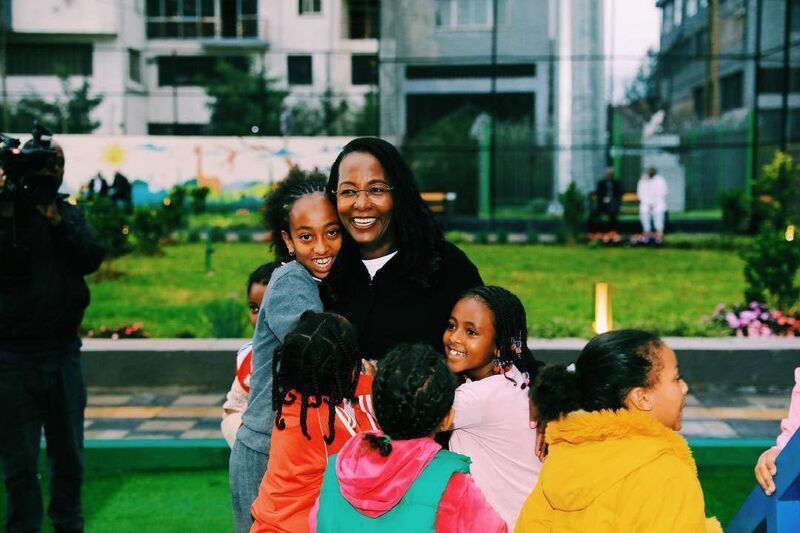
Addis Ababa, in particular, has witnessed an expansion of safe, modern playgrounds and child-friendly public spaces—something unimaginable for many who grew up during the 1970s and 1980s.