
The Awash Fentale volcano in the Afar region, erupted in January 2025, approximately 165 kilometers (102 miles) from Addis Ababa, affected many citizens.
By Mekonnen Teshome
The Ethiopian Building Proclamation No. 1356/2024 is a comprehensive legal framework that regulates the construction sector in Ethiopia by enforcing standardized design, mandatory permits, and strict supervision to ensure safety, accessibility, and compliance with urban plans. Among the safety rules it stipulates are construction safety, environmental and waste management, and fire safety.
The city’s skyline is changing fast, filled with high-rise buildings and new developments that show off Ethiopia’s growing economy. But under all this growth lies an important reality: the city sits along the seismically active East African Rift System.
As the capital builds higher and faster, safety has to come first. Under the Ethiopian Building Proclamation, legal rules now strictly enforce structural safety, proper waste and fire management, and smart urban planning. Designing buildings that can handle earthquakes is no longer optional—it is essential for protecting lives and investments.
In the first week of October 2026, Ethiopia updated its national building codes to enforce stricter seismic safety requirements, establish protocols for evaluating older structures, and account for regional wind variations and advanced construction materials, experts disclosed at an engineering summit in Addis Ababa.
According to The Reporter newspaper, the new building code was unveiled during the 27th Ethiopian Association of Civil Engineers (EACE) Convention and International Infrastructure Conference 2026, held at the Sheraton Addis Hotel, where industry leaders outlined the technical shifts accompanying the country’s rapid infrastructure expansion.
Why focus on Addis Ababa?
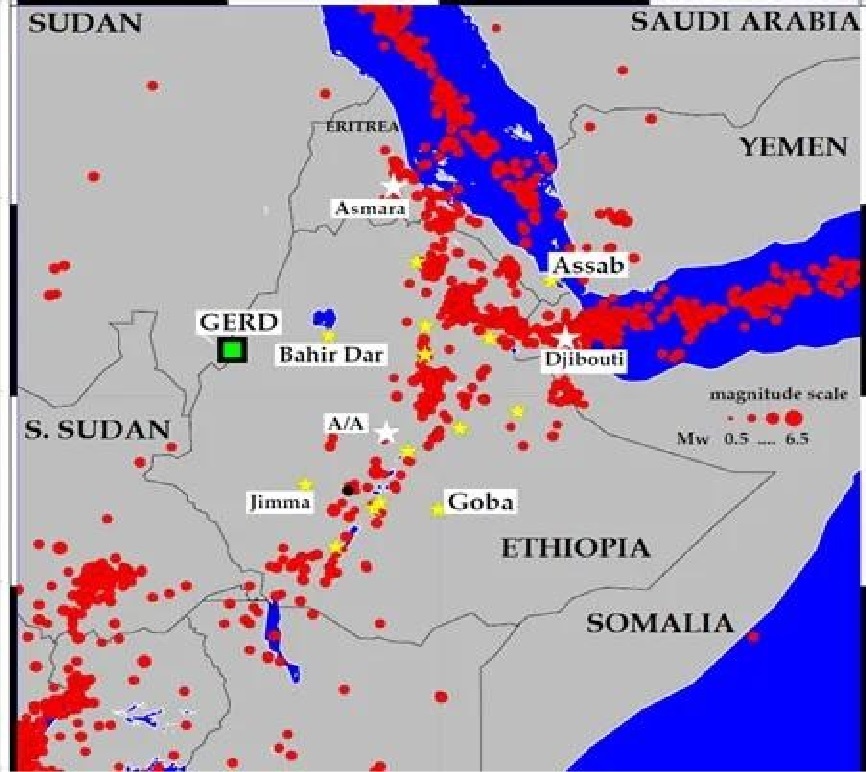
Addis Ababa, which is the capital of Ethiopia and the economic and political center of the country, sits near the edge of the Ethiopian Rift System—a region prone to moderate earthquakes. Because local soil properties directly influence how earthquake waves travel, amplify, or diminish, analyzing site conditions is essential for assessing seismic risk in the city.
According to a paper presented at the 13th World Conference on Earthquake Engineering in Vancouver, B.C., Canada some years back, a critical case for Addis Ababa could be the recurrence of earthquakes ever recorded since 1906. It was in the public record that an earthquake of magnitude 6.8 occurred at an epicentral distance of 100 km or less from Addis Ababa in 1906 for the first time.
This natural phenomenon has been there since antiquity; for example, if we see the recent ones, between 2021 and 2026 alone, seismic activity in the Main Ethiopian Rift (MER) and the Afar Triple Junction transition zone experienced a significant escalation. While 2021 through mid-2024 was marked by baseline extension movements along the East African Rift System, late 2024 through early 2025 saw one of the most intense seismic and volcano-tectonic swarms recorded in central Ethiopia in decades.
In January 2025, ReliefWeb reported that approximately 99,000 people across three regions were affected: 60,000 in Afar, 20,000 in Oromia, and 9,000 in Amhara. Many residents expressed uncertainty about appropriate protective actions in the face of volcanic risk. Around 90,000 individuals had already been displaced, and the government evacuated them to safer places within their respective zones.
How Earthquake-Resistant Engineering Works
Designing an earthquake-safe building isn’t about making it rigid; it’s about making it flexible. Instead of trying to fight the ground’s immense movement, modern engineering focuses on absorbing and releasing that energy.
With regard to “ductility (flexibility),” beams and columns are designed to bend under stress rather than snap, keeping the building upright during severe shaking. Another approach is “smart balancing,” where engineers balance strength and stiffness so a building’s natural sway does not match and multiply the ground’s shaking frequency.
The principle of “even distribution” is also critical in creating symmetrical shapes and clear support pathways that spread stress evenly across the structure, avoiding weak spots like soft ground floors.
Building Codes and Materials
To put these safety ideas into practice, developers follow the Ethiopian Building Code Standard (specifically EBCS 8, which is based on European standards). This code sets rules for everything from soil testing to ground movement risks.
Material choices are just as important:
- Reinforced Concrete: Pairs concrete’s strength under pressure with steel rebar’s ability to pull and stretch, creating strong yet flexible frames.
- Structural Steel: Naturally strong, light, and elastic, making it ideal for tall buildings that need to absorb ground motion.
- Modern Materials: Carbon-fiber composites, reinforced masonry, and engineered timber help reduce a building’s weight while keeping it strong.
Protecting Interior Spaces
An earthquake can turn non-structural elements—like light fixtures, heavy furniture, and gas pipes—into immediate hazards. Full seismic planning looks at the inside of the building too:
- Lightweight Partitions: Using drywall on metal studs cuts down on heavy falling debris.
- Secured Utilities: Gas, water, and power lines use flexible connectors and diagonal braces so pipes don’t snap and cause fires or flooding.
- Safe Exit Routes: Emergency lights and clear paths stay functional during a power outage so people can evacuate safely.
Modern Technology Application and Upgrading Older Buildings Before ground is broken, engineers use software like Finite Element Analysis and Building Information Modeling (BIM) to run simulations and spot structural weaknesses early.
For major high-rises, advanced tools offer extra protection. Base isolation decouples a building from its foundation using flexible rubber-and-steel bearings, drastically reducing how much ground motion reaches the floors above. In addition, dampers act like giant shock absorbers inside the frame to control swaying.
Because much of Addis Ababa was built before modern earthquake codes were established, retrofitting existing buildings is a top priority. Techniques like adding steel walls, wrapping columns in carbon fiber, or adding concrete jackets allow older structures to be upgraded securely. Through smart coding, high-tech tools, and retrofitting, the city is making sure its rapid growth stays safe for the long haul.
Seismic and Earthquake Zonation and Mapping as a Solution
Therefore, our engineers should prioritize seismic considerations and earthquake zonation mapping in Addis Ababa primarily because of the city’s proximity to the Main Ethiopian Rift, an active tectonic boundary within the East African Rift System. Because Addis Ababa sits on the western margin of this rift, it is regularly exposed to seismic risks from active fault lines and volcanic zones nearby.
Zonation mapping allows structural engineers to understand peak ground acceleration (PGA) and expected ground motion levels in different parts of the city. By identifying these seismic hazard levels, engineers can properly apply national building codes (such as EBCS-8) to mandate adequate structural ductility, concrete frame reinforcement, and deep foundation designs that prevent catastrophic collapses during ground tremors.
Beyond regional fault activity, zonation mapping is vital for evaluating local geotechnical conditions across Addis Ababa, which vary significantly from soft alluvial soils in low-lying basins to solid volcanic rock on higher ground. Soft soil layers tend to amplify ground shaking and increase the risk of soil liquefaction or differential settlement under dynamic loads, putting mid-rise and high-rise developments at elevated risk.
Integrating seismic zonation data into structural design enables engineers to tailor foundation engineering, shear wall placement, and lateral load-resisting systems specifically to local soil amplification factors. This science-driven approach ensures structural resilience, protects human lives, and safeguards critical urban infrastructure against future earthquake hazards.
In general, seismic risk must be assessed both citywide and through site-specific studies. These should look closely at soil amplification, liquefaction potential, fault proximity, ground motion, and foundation response. It was highlighted that soil conditions in Addis Ababa vary widely, meaning seismic zoning must directly guide structural and foundation design.
Incorporating Addis Ababa University research on active seismic zones in the Main Ethiopian Rift—especially their recommended safety measures for buildings and infrastructure—would add significant value.
The seismic safety measures must extend to major strategic developments near Bishoftu (Debre Zeit), just 45 km from Addis, including the new mega-airport. Before and during construction, teams should thoroughly evaluate seismic hazards, fault lines, soil stability, liquefaction risk, foundation behavior, and critical infrastructure resilience.
In terms of lessons, Japan offers a strong model here. Instead of relying solely on stronger buildings, Japan combines seismic zoning, site testing, flexible (ductile) design, base isolation, dampers, monitoring systems, and strict quality control. Ethiopia can adapt these methods to fit its local geology.
This is also an opportunity to lead technical transformation: designing for true resilience, not just basic code compliance.