By African Demystifier
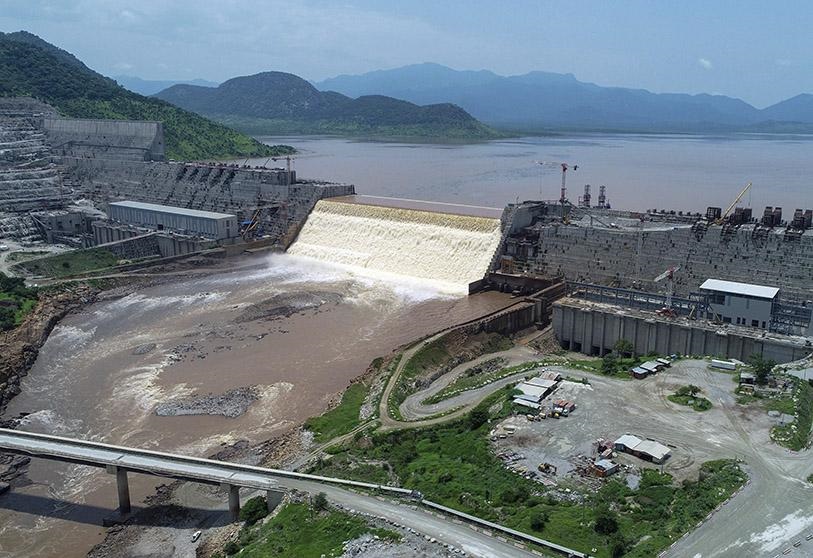
Ethiopia says Arab League serving as the spokesperson of one state [Egypt] and has denounced the League’s latest ‘resolution’ over the $5 billion Grand Ethiopian Renaissance Dam (GERD) construction on the main tributary of the River Nile. “The League is once again serving as the spokesperson of one state, disregarding basic principles of international law
The dam has been a source of a decade-long diplomatic standoff between Ethiopia and downstream nations Egypt and Sudan.
“We should not have to remind the League that the Nile River and all the riparian countries are found in Africa.
“Such attempts to politicize the issue of GERD neither advance friendly relations nor support the efforts to arrive at amicable solutions, as they are not based on facts or supported by law,” the statement read. The downstream countries claim they fear the dam could reduce the water flow of the Nile River – a stand strongly disputed by Addis Ababa.
The Council of Arab Foreign Ministers meeting held under the presidency of Cairo passed a ‘resolution’ backing “Egypt’s water rights on the Nile.”
The ministers, media reports say, also decided to take the matter to their meeting with European foreign ministers in June.
In a statement today,Ethiopia criticized Egypt’s latest push to politicize and internationalize the matter and equated the Arab League’s resolution with interference in African matters.
The East African nation also expressed dismay at the Arab League’s “resolution” regarding the filling and operation of the GERD.
Ethiopia says ‘Resolution not backed by Law‘
The spokesperson office of the ministry of foreign affairs of Ethiopia said:“The management and utilization of the Nile River, including the filling and operation of the GERD, must be left to the concerned parties in Africa,”
Authorities say a few outstanding issues remain unresolved in the trilateral negotiations facilitated by the African Union. The talks, however, stalled after Egypt and Sudan circumvented the AU-led process and took the issue to the UN security council a year ago.
The latest Arab league resolution accuses Addis Ababa of having taken an ‘obstinate stance’ on the GERD, siding with Cairo’s claim of “commitment of protecting the rights”.
In response, Ethiopia’s foreign ministry called the Arab League’s characterization of the negotiations “incorrect”.
“The fact is that Egypt with its obdurate stance to maintain a colonial era-based self-claimed water allocation and its unending attempts to internationalize the matter is the reason for the delay of the negotiation,” the ministry said.
The Ministry noted that only good faith negotiations could resolve the dam dispute, stating Ethiopia’s commitment to the AU-led talks “guided by the maxim, African Solutions to African Problems.”
However, “the League’s resolutions and statements by Egypt call into question whether Egypt has been engaged in good faith in the negotiations under the AU’s auspices,” it added.
Dam’s Filling & operation based on the 2015 DoP
Ethiopia, a source of 85% river Nile water, is filling the GERD reservoir during its rainy season to allow the river to continue flowing to downstream countries.
The last trilateral talks failed to yield a three-way agreement on the dam’s filling and operations. Cairo wants Addis Ababa to cease filling the reservoir until such a deal is reached. Ethiopia, however, insists that the filling is a natural part of the dam’s construction process and cannot be stopped.
Ethiopia says its approach to filling and operation of GERD is crafted based on the bounds of the Declaration of Principles (DoP) signed by Ethiopia, Egypt, and Sudan in 2015, and subsequently negotiated rules and guidelines.
“Ethiopia continues to fill and operate the GERD… with full respect to the principle of equitable and reasonable utilization of transboundary water resources,” the foreign ministry said.
The process of filling the reservoir began in the 2020 rainy season, collecting a target of 4.9 billion cubic meters (BCM). The following year, the reservoir held 13.5BCM water.
The third round of filling last year, which brought the volume of water in the reservoir approximately to 22BCM, concluded a day after the dam’s second turbine with a 375-megawatt electric generating capacity began producing power.
Upon completion, the dam will have the capacity to generate 15,760 GWh of energy a year with 13 turbines on average.