CAMS organic matter aerosol optical depth at 550nm 5-day forecast initialized on 10 May at 00 UTC. Source: CAMS
Climate Change
In a press statement Copernicus sent to www.africandemystifier.com , two significant wildfire episodes are affecting the Northern Hemisphere: one in Alberta, Canada and a second in central and east Russia. These wildfires are impacting forests, human settlements and the air quality on a larger scale. The Copernicus Atmosphere Monitoring Service (CAMS) has been monitoring these situations, particularly tracking their intensity through Fire Radiative Power (FRP) that can be observed from these wildfires and how the smoke is affecting the composition of the atmosphere.
Wildfire activity in western Canada has been reported since 4 May, reaching a total of 29 fires in Alberta as of 8 May. Using satellite observations, CAMS has been monitoring a significant increase in daily total intensity and resulting carbon emissions from these fires which has reached over 5 megatons so far this year, being the highest for April and May since 2019 as of 8 May. These fires have produced a large plume of smoke that has crossed Canada towards the northeastern USA in recent days and is predicted to continue to the Atlantic Ocean in the coming days. As the wildfire situation in the region develops, CAMS will continue to monitor the situation and provide updates accordingly.
As for Central and eastern Russia, seasonal fire activity started in April, but has increased during the first week of May. CAMS FRP data show active fires burning in a band stretching from Russia’s Chelyabinsk region across Omsk and Novosibirsk regions to Primorye in the Far East, affecting also Kazakhstan and Mongolia. Despite the increased daily total FRP in these regions of Russia, it is worth noting that the total estimated wildfire carbon emissions for April and May are below average for the period as of 9 May.
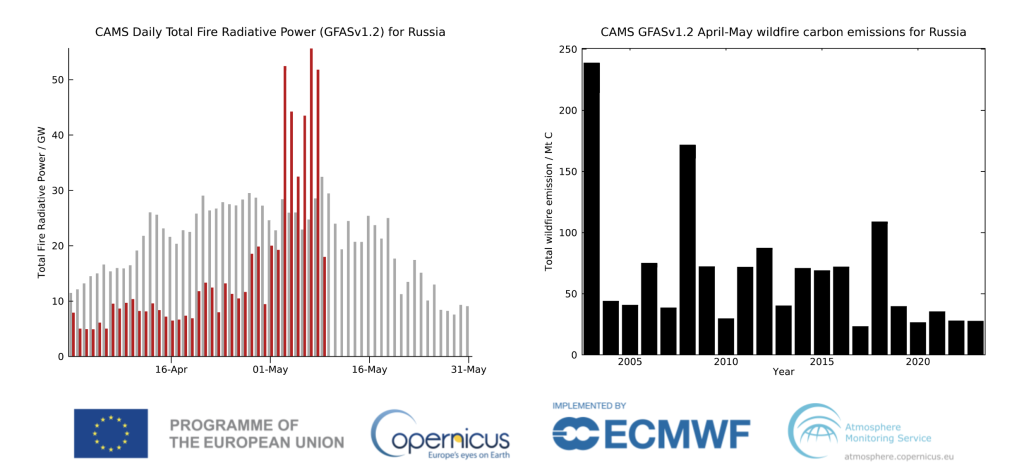
“The scale and intensity of the current fires are reflecting increased fire risk following some weeks of drier than usual conditions. Wildfires are not particularly unusual in the boreal forests spring, and we have monitored fires in both Canada and Eurasia at this time of year in the past. Nonetheless continue to monitor these conditions as we approach summer when the boreal fire season starts to reach its peak” said CAMS Senior Scientist, Mark Parrington.
CAMS has been assessing the situation using its Global Fire Assimilation System (GFAS) data, which is based on satellite observations of active fires, to provide information on the distribution, daily total intensity and corresponding emissions to the atmosphere of the observed fire activity.
CAMS provides up-to-date information on the location, intensity, and estimated emissions of wildfires around the world, including the tracking of their smoke transport and impacts on atmospheric composition. CAMS data is freely available to use and can serve as a vital aid in decision-making processes for citizens, businesses and stakeholders in related sectors alike.