– Rains Also Bring Hope to Nation ’s Drought Affected Regions
By Mekonnen Teshome Tollera (Science and Climate Writer)

The South and South-eastern Ethiopia will receive unexpected rainfall in the next season that extends from October 2023 to January 2024, Ethiopian Meteorological Institute (EMI) announced.
As the rainfall brings hope to the drought-affected areas, it also poses a risk of flash floods that would have devastating effects on the local communities and their agricultural as well as livelihood activities, according to the Meteorological Institute.
Ethiopia’s National Climate Outlook
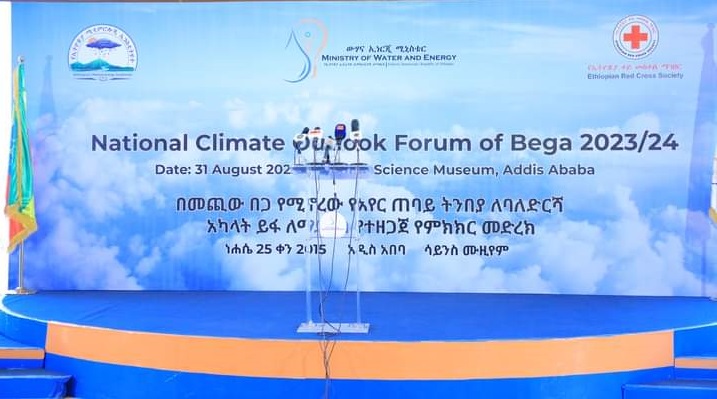
Presenting his report on the “National Climate Outlook Forum of ‘Bega’ 2023/24” at the Science Museum , Ethiopian Meteorological Institute Director General, Mr. Fetene Teshome pointed out that the above average rainfall predicted to happen across South and South-eastern Ethiopia is attributed to El Niño events which causes a wetter weather conditions in East Africa.
According to Mr. Fetene, the heavy rains are also predicted to be the result of Positive Indian Ocean Dipole (IOD), a phenomenal created due to difference in sea surface temperature between two areas.
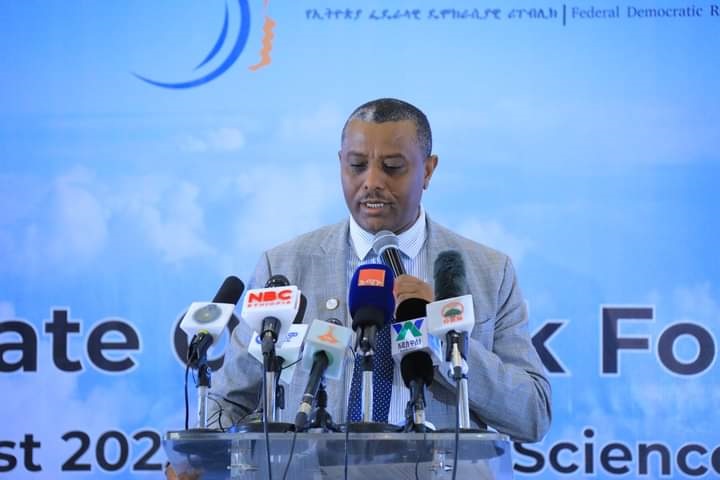
The Director General further explained that much of the northern, northeastern, eastern and central Ethiopia would have average normal and erratic rainfalls that could in turn result in flash floods and , Fetene added, that the southwestern and western portions of the country will dominantly receive normal rainfall with occasional heavy rainfall pattern.
On the other hand, above normal to slightly near-normal temperature is expected over the eastern, central and southeastern parts of the country, he said.
The prediction shows that events of El Niño and Positive Indian Ocean Dipole are expected during the coming rainfalls of the “Belg” and “Kiremt” seasons while normal to above normal rainfalls are forecasted to prevail across southern and southeastern region of Ethiopia, the Director General said.
State Minister for Agriculture Dr. Meles Mekonnen who attended the national outlook release forum also said the above average rainfalls, if properly utilized, could be beneficial for agriculture activities, livestock husbandry as well as water resource management.
The State Minister indicated that the above average rainfall predicted to dominate in some parts of the country, could be a good opportunity for the irrigated “Bega Wheat” development projects if harnessed properly.
He told the forum that his Ministry would seriously consider and make use of the meteorological institute’s Early Warning reports to properly lead the agricultural sector and minimize potential risks including flooding and landslides.
Regional Seasonal Outlook Aligns EMI’s Report
The IGAD Climate Prediction and Application Centre (ICPAC), a World Meteorological Organization (WMO) Regional Climate Centre, in its seasonal outlook for the next October to December 2023 rainy season also forecasts similar above average rainfall In the Greater Horn of Africa in events of El Niño and Positive Indian Ocean Dipole.
According to ICPAC, after three years of devastating drought events, the Horn of Africa finally emerges from the situation; however, the above average rainfall is predicted to be accompanied by the risk that flooding will affect local communities and their livelihoods.
The new seasonal outlook indicates that there are high chances of wetter-than-usual conditions across most parts of the Greater Horn of Africa and particularly there is an exceptionally high probability (more than 80%) of experiencing wetter-than-usual rainfall in southern Ethiopia, eastern Kenya, and southern Somalia.
On the other hand, drier-than-usual conditions are likely for isolated areas of southwestern Uganda and south-western South Sudan, the regional prediction shows.
Warmer-than-usual Surface Temperatures
“For October-November-December 2023, the consolidated objective temperature forecast from nine Global Producing Centres indicates an increased likelihood of warmer-than-usual surface temperatures for almost all parts of the Greater Horn of Africa, particularly over Djibouti, Eritrea, northern Ethiopia, northern Somalia, and parts of coastal Tanzania.”
“The devastating drought associated with the three-year-long La Niña event may be replaced by a deluge because of the new El Niño event which typically means wetter than usual conditions in East Africa,” says Dr Wilfran Moufouma Okia, head of regional climate prediction services at WMO.
“Another climate phenomenon known as the Indian Ocean Dipole is developing over the Indian Ocean and may strengthen the El Niño impacts,” he further elaborated.
The drought, which began with the poor performance of the October-December 2022 rainfall, led to a humanitarian disaster. It affected millions of people, especially in Ethiopia, Kenya and Somalia, killed millions of livestock and destroyed crops.
Much of the region saw heavy rainfall from March to May 2023. The above-average precipitation from October to December may therefore contribute to flooding. October to December constitutes a vital rainfall season, particularly in the equatorial parts of the Greater Horn of Africa, contributing 20 to 70% of the annual total rainfall.
Desert Locusts Proliferation
Dr Guleid Artan, ICPAC Director Underscores: “Desert locusts are already proliferating to alarming levels in parts of the region. The risk of deadly incidents also increases significantly. We all remember the last El Niño in 2015/16 when downpours of torrential rains caused landslides, flash floods, and buildings to collapse. Governments and disaster management agencies are advised to take all necessary measures to save lives and livelihoods.”
The start of the season will likely occur early in parts of the region where elevated rainfall is anticipated (eastern Kenya, southern Somalia, and eastern Tanzania). In contrast, probabilities favour an average or delayed onset over parts of northern Somalia, western Kenya, Uganda, southern South Sudan, Rwanda, Burundi, and north-western Tanzania.
The one-day seasonal IGAD – ICPAC outlook release forum brings together climate scientists, researchers, governmental and non-governmental organizations, development partners and civil society and the seasonal forecast is based on rigorous analysis of historical data, prevailing climate signals, and advanced modeling techniques.
- The writer of this piece – Mekonnen Teshome (Science and Climate Writer) , can be reached via his email mokish03@gmail.com or his Cell phone +251911152603