By Mekonnen Teshome
Addis Ababa, Ethiopia: Masdar , UAE’s renewable and green hydrogen energy global flagship company, is committed to help Ethiopia and other African countries to advance and realize their renewable energy transition goals , company adviser said.
The Masdar adviser, Martin Nagell, who was approached by this writer at the recent Accelerated Partnership for Renewables Africa (APRA) forum in Nairobi, Kenya, said that Masdar is undertaking activities to catalyze renewable technology investments in Africa as part of its government-to-government partnership with countries in the continent.
Through the Abu Dhabi government authorities, the company has signed agreements to help African countries harness their renewable resources and ensure access to clean and affordable energy, Nagell said.
He recalled that, during the 28th Conference of the Parties (COP28), the company promised to develop 10 GW of installed capacity in six sub-Saharan African countries in seven years to contribute to the realization of Africa’s renewable energy targets and energy transition.
Nagell indicated that the UAE government has already shown its readiness to assist Ethiopia to develop its abundant renewable energy resources through Masdar especially to build solar photovoltaic (PV) plants.
If African governments can develop and use solar power, they will save significant amount of money as it is the cheapest source of energy and it will enhance their competitiveness in the industry and supply electricity to their consumer with a reasonable cont, Nagell underscores.
According to International Renewable Energy Agency (IREN), Africa has huge energy access deficit and receives the smallest share of the global investment in renewable energy, only less than 2%.
Renewable Energy Advisor of the Ethiopian Ministry of Water and Energy Temesgen Tefera pointed out that that Ethiopia has huge renewable energy potential and UAE’s assistance in the development of clean energy in the country would be of great value.
“I know that UAE has been involved in renewable energy development in Ethiopia, and now as part of this year’s APRA, we have pitched the idea of developing bio-gas and solar energy hybrid project to partners and it was highly appreciated.”
“We anticipate a more detailed discussions and technical assistance from IRENA for the realization of the proposal.”
The Wolayita Sodo University in Ethiopia has successfully build a big bio-digester to generate bio fuel and that can be a gate way for the bio fuel and solar hybrid renewable energy in the country, Temesgem added.
The Ethiopian Bio and Emerging Technology Institute (BETin) has also undertaken various renewable energy projects and capacity building trainings especially on the development of community level biogas facilities.
Kinfegebreal Kebede, Reverse Engineering and Directorate Director and Senior Researcher at BETin indicated that his institute together with experts from the Wolayita Sodo University facilitated capacity building trainings in Wolayita and that should also continue in the time to come.
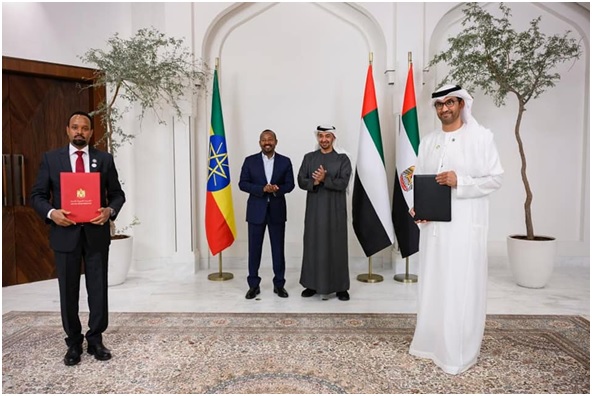
In January 2023, Ethiopia and Masdar signed a Joint Development Agreement (JDA) enabling the two parties develop two solar photovoltaic (PV) plants with a combined capacity of up to 500 megawatts (MW) in Ethiopia.
Masdar, also known as the Abu Dhabi Future Energy Company, is a UAE-government owned renewable energy company based in Abu Dhabi, United Arab Emirates.
“Masdar has been a catalyst for renewable energy and clean-tech innovation in more than 30 countries around the world, and we look forward to working with the Government of Ethiopia to help deliver universal access to electricity for all its people.”
Ethiopia generates 100% clean energy from hydro-electricity and it has designed a National Electrification Program aiming at achieving universal energy access by 2025, and to become a power hub in Eastern Africa.
As over half of its population still lack direct access to electricity, the country is making efforts in diversifying its energy mix with wind, solar, and geothermal and reduce its dependence on hydropower as it depends on rainfall and is being affected by climate change.
The Accelerated Partnership for Renewables in Africa (APRA), an African country-led international alliance of governments and stakeholders, spearheaded by IRENA held its first forum in Nairobi , Kenya from October 14-16 , 2024.