By Mekonnen Teshome
Addis Ababa, Ethiopia | 11 February 2026 — Africa’s top scientists as well as policymakers, and development partners have called for urgent reforms in research financing, incentives, and innovation systems to unlock the continent’s research and development (R&D) economy and accelerate sustainable growth.
The research experts made the call during a media briefing today in Addis Ababa convened by the Calestous Juma Science Leadership Fellows (CJ Fellows) on the margins of the African Union Heads of State and Government Summit in Addis Ababa.
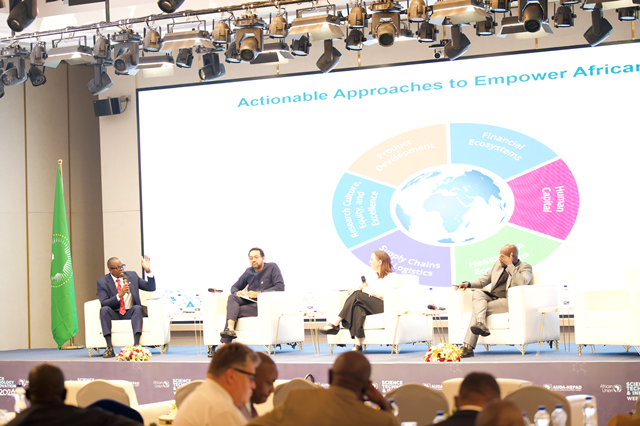
Held as part of AUDA-NEPAD ’s Science, Technology and Innovation (STI) Week at the Ethiopian Skylight Hotel, the session brought together health ministers, senior government officials, researchers, private sector leaders, and media representatives.
Organised by the Science for Africa Foundation (SFA Foundation) and the African Union Development Agency (AUDA-NEPAD), the forum addressed a persistent structural challenge: Africa’s growing scientific capacity is not matched by systems that convert research into scalable industries, jobs, and social impact.
Science as economic infrastructure
At the occasion Dr Moses Alobo, Head of Programmes for Science, Innovation and Entrepreneurship at the SFA Foundation, also urged governments to recognise science as a strategic economic investment.
“Africa does not lack ideas or talent. What we often lack are policy environments that allow research to translate into impact,” he said, emphasising the importance of science diplomacy and sustained researcher engagement in policymaking.
AUDA-NEPAD officials echoed the call, highlighting the need for practical, locally grounded solutions that advance Agenda 2063 through stronger national and regional innovation frameworks.
Evidence, innovation, and health on one platform
The panel featured three CJ Fellows with complementary expertise:
- Prof Nicki Tiffin, South African National Bioinformatics Institute, University of the Western Cape
- Dr Yaw Bediako, Chief Executive Officer, Yemaachi Biotech, and Dean of Research and Innovation, Ashesi University
- Dr Vincent Okungu, Senior Researcher and Health Economist, University of Nairobi
Moderated by George Ndirangu of the Africa Leadership and Dialogue Institute, the discussion concluded that Africa’s research constraints stem less from limited talent than from structural financing gaps, weak development pipelines, and restrictive policy environments.
Barriers to R&D competitiveness
Panelists highlighted several interlinked challenges:
Low and fragmented financing. Most African countries invest only 0.3–0.4 per cent of GDP in R&D, far below the 1 per cent target. Speakers stressed that sustainable growth requires stronger private-sector participation supported by public incentives and risk-sharing mechanisms.
Weak development pathways. While research output is increasing, many projects fail to progress beyond publication. Limited capacity in product development, regulation, and commercialization continues to block the transition from discovery to market.
High cost of innovation. Prof Tiffin cited import duties on donated research equipment as an example of how existing regulations can undermine competitiveness. Panelists urged governments to treat research infrastructure as a strategic national asset.
Limited private-sector engagement. Despite available capital, science-based ventures remain underfunded and poorly positioned as investable industries.
Talent retention risks. Insecure career pathways and limited institutional support continue to drive skilled researchers abroad, weakening long-term research ecosystems.
Health research as economic resilience
Dr Vincent Okungu explained to reporters regarding health R&D as a cornerstone of Africa’s economic and social stability : “Health research is not a cost centre. It is long-term economic infrastructure,” adding, that noting that sustained investment reduces disease burdens, strengthens productivity, and lowers dependence on imported technologies.
He called for predictable, long-term funding models aligned with national development outcomes, particularly in areas where Africa bears a disproportionate disease burden.
Policy priorities for 2026–2034
The CJ Fellows outlined practical reforms for the coming decade:
- Establish clear national R&D priorities linked to economic and social impact
- Develop public–private derisking mechanisms to attract private investment
- Introduce fiscal and regulatory incentives, including duty exemptions for research equipment
- Create transparent monitoring dashboards to track R&D spending and outcomes
- Strengthen university-based translation and commercialization offices
- Institutionalise diaspora investment and collaboration platforms
Dr Bediako highlighted the role of targeted incentives, such as biotechnology free zones, in positioning innovation as a competitive export sector.
From knowledge to impact
The Fellows concluded that Africa’s central challenge is no longer producing knowledge, but financing, governing, and scaling it into viable solutions.
Participants agreed that the next decade must focus on execution—building successful, well-supported innovation models that demonstrate returns, attract private capital, and strengthen confidence in Africa’s science economy.
The dialogue reinforced the growing alignment between researchers and policymakers and underscored the role of evidence-based decision-making in advancing Africa’s competitiveness, resilience, and inclusive development.