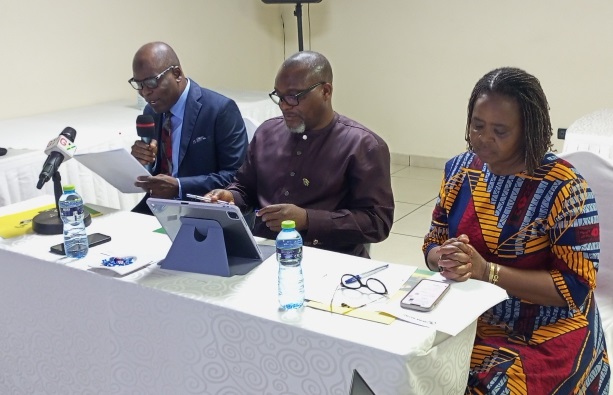

Accra, Ghana (January 29, 2024) : The African Union Development Agency (AUDA-NEPAD) says that Africa needs to transform its agricultural sector through the use of cutting-edge technologies like Genome Editing (GEd).
While addressing participants at the opening session of a two-day training workshop for communicators today in Accra, Ghana, Mrs. Florence Nazare, Head of the Centres of Excellence, Management and Coordination Unit of the African Union Development Agency (AUDA-NEPAD), emphasized the need to revolutionize Africa’s agriculture through the adoption of cutting-edge technologies like genome editing and ultimately realize industrialization in the continent.
“Genome editing provides solutions to ensure food security through enhanced agricultural production and to improve livelihoods. Participants will share their experience and expertise to come up with a set of modules to improve communication modules,” Mrs Nazare underscores the objectives o the workshop.
The head also urged African communicators and media professionals to help the citizenry understand the advantages of the science in agricultural biotechnology and how it is safe and enhances productivity.

Media Plays Critical Role In Demystifying Genome Editing
Director of Science, Technology, and Innovation of the Ministry of Environment, Science, Technology, and Innovation of Ghana, Mr. Kwamena Essilfie Quaison, while delivering the opening speech also has called on journalists and science communicators to contribute their share in assisting in popularization of Genome Editing technology among the general public in Ghana.
According to the Director, the national Genome Editing Communication and Advocacy document has been finalized and is ready for implementation in Ghana. “Today’s training workshop represents the first activity under the implementation phase and marks a significant milestone in the life of the a project of this science,” he added.
The director also underscores that the media has to support the creation of scientific culture in Ghana and to create public confidence on emerging modern biotechnology sciences including genome editing among the general public. “Citizens ought to be informed appropriately and adequately about the role such emerging technologies as modern biotechnology play in our development agenda and appreciate the science behind biotechnology,” he added.
Mr. Quaison called on communicators to work towards building a society that appreciates science and innovation together with genome editing as scientific technologies are means and gateways for the modernization and transformation of the agricultural sector. This , according to him, needs a transformed and improved way of agricultural and science communication, he added.
Gene editing is part of the implementation of AU’s Second 10-Year Plan and builds on the gains of the first 10-Year Plan. There is a need to communicate all elements to feed into the innovation ecosystem.
Genome Editing among the most promising and innovative technologies
According to AUDA-NEPAD, Gene editing is among the most promising and innovative technologies to help optimise and sustain agricultural breeding towards enhancing African value chains and food systems to accelerate industrialisation on the Continent.
The training workshop is part of AUDA-NEPAD’s effort to explore how to harness the genome editing technology in the African context for increased productivity, resilience, and adaptation to climate change as well as issues diets, mechanization, storage and food safety.
AUDA-NEPAD encourages scientific dialogs about the science to leapfrog and optimise Africa’s agriculture and food systems performance along the CAADP-Malabo targets.
AUDA-NEPAD playing a development drive role, brings together policy makers, researchers, practitioners, businesses and partners to show-case and share insights on genome editing innovations. It also assists African countries to lay the foundations of legal instruments for future gene editing practices.
It also supports African nations to expand uptake of genome editing science to accelerate breeding and adaptation programmes in agriculture and food systems.
Science communicators and journalists, public relations practitioners, information officers and scientists are in attendance in the training workshop opened today in Accra, Ghana.