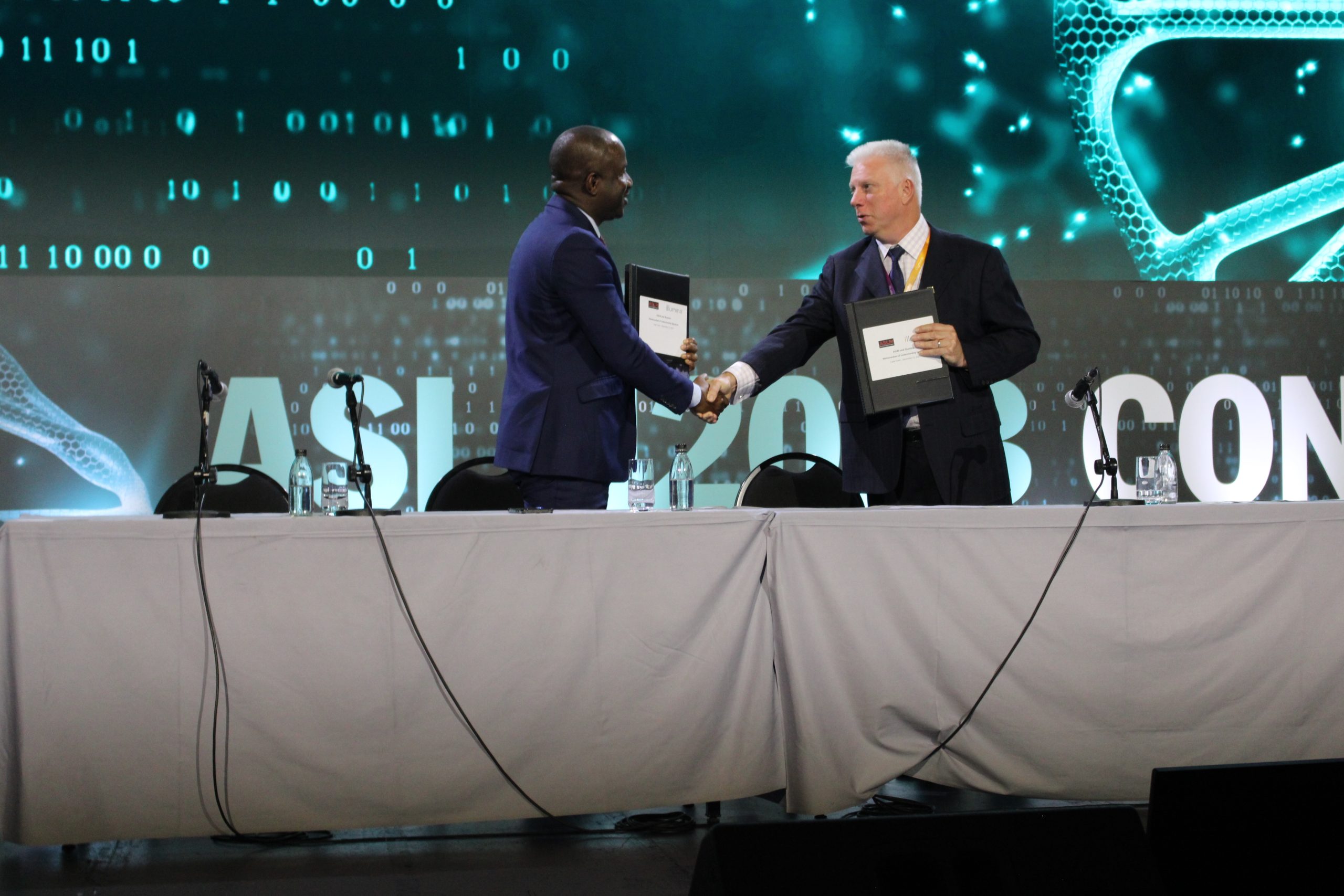
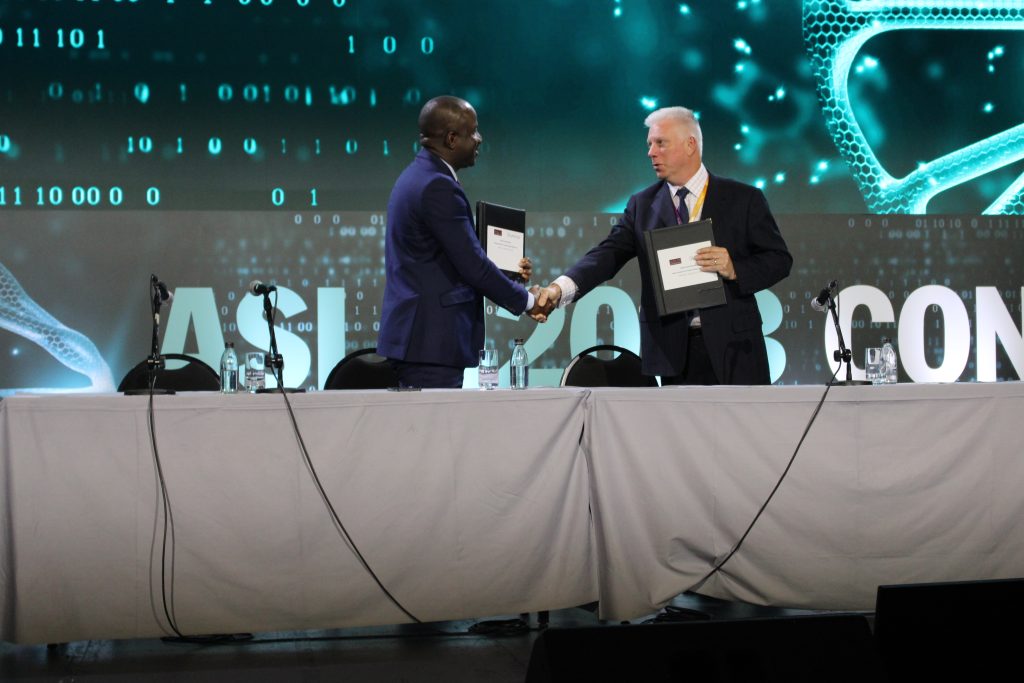
ASLM (Left) and Tom Berkovits, Senior Director Asia Pacific, Middle East &
Africa (Right) exchanging the signed documents
Cape Town, South Africa: The African Society for Laboratory Medicine (SLM) and Illumina, an American biotechnology technology provider company, headquartered in San Diego, California, Wednesday signed a MoU to facilitate cooperation efforts on genomic sequencing and surveillance so as to combat infectious diseases in Africa.
The two parties signed the MoU during the 6th biennial conference of the African Society for Laboratory Medicine (ASLM) held in Cape Town, South Africa with the theme: “21st Century Laboratory Medicine Practice in Africa: then, now and future”, 12th to 15th December 2023.
The agreement is expected to enable ASLM and Illumina closely work in the application of genomic sequencing to monitor infectious diseases and outbreaks and identify public health interventions and responses in Africa and strengthen Africa’s health system against future pandemics.
After signing the MoU the two parties have indicated that the agreement is meant to reinforce capacity building in the African countries on the science of genomics sequencing through ASLM’s Academy.
According to the initiative ASLM will facilitate access to pathogen genomic sequencing capacity building programs to fortify Africa’s capacity against future pandemics and infectious diseases.
“The initiative is fundamental to build our capacities in genomic sequencing and monitoring of pathogens, to produce skilled workforce that can do genomic sequencing in Africa,” ASLM CEO Mr. Nqobile Ndlovu told African Demystifier.
The CEO said: “Genomic sequencing is a very powerful tool that you use to identify pathogens or the organisms that are causing an outbreak.”
“It is really about testing an organism through identifying its genes, its DNA. Because that is unique to every organism. That is how powerful it is. That’s why as Africa it has become important because Africa has the largest burden of infectious diseases. Some of them are still new,” Nqobile has explained.
He further indicated : “It is very specific and very accurate. That’s why it is this powerful. It is a test that is a little bit complicated. But just to make it simple, it is one of the powerful ways of testing and actually confirming any particular pathogen that you can have.
According to the CEO, Genomic sequencing is now very important in the laboratory science because in addition to identifying the pathogen, it is useful to tell where a DNA comes from, the origins can be
tracked. “It gives you so much information and even when the pathogen begins to change, because over time the pathogen changes.”
“When they [DNAs] change, sometimes they can cause serious infections. For example, we had COVID, then it changed to Omicron. For you to be able to tell that it is changing, you need this genomic testing.”
Nqobile recalled that COVID19 was a new thing and further said that COVID would not be identified if genomic sequencing was not used. Pathogenomics is the tool that can identify any unknown organism that can come in the continent.
“So as a continent, we need this capacity because previously we used to send our samples outside the continent because they have these powerful machines, these powerful testing technologies. We didn’t have it. But we are saying moving forward, we need that capacity in Africa.” The CEO underscores.
Dr. John N. Nkengasong, U.S. Global AIDS Coordinator and Special Representative for Health Diplomacy/PEPFAR/ also earlier in a videotaped talks said that Africa needs to be a leader in genomic surveillance because emerging diseases threaten Africa’s development trajectory, its future medicine should be precision and and it needs to fuel its leadership in medical innovation.
Dr. Nkengasong has also delineated that the future of Africa’s laboratory medicine would be determined by factors of genomic surveillance and Artificial Intelligence (AI) related to data culture, regulatory standards, adoption of local solutions, funding and infrastructure.
Illumina Company Senior Director Marketing, Asia Pacific, Middle East and Africa Mr. Tom Berkovits, on his part indicated that his company regards the MoU as an important engagement with a key African organization to push Illumina’s commitment in advancing global health, particularly in the continent where genomics could play a critical role to public health advancements.
“I think genomics is important. It has been important, right the way through. But the technology for a long time was quite complicated and quite expensive. But what COVID showed was that we needed to build capacity in Africa.” Mr. Berkovits said.
The genomic sequencing effort will contributes to detecting and responding to infectious disease outbreaks and to address related challenges, he said.