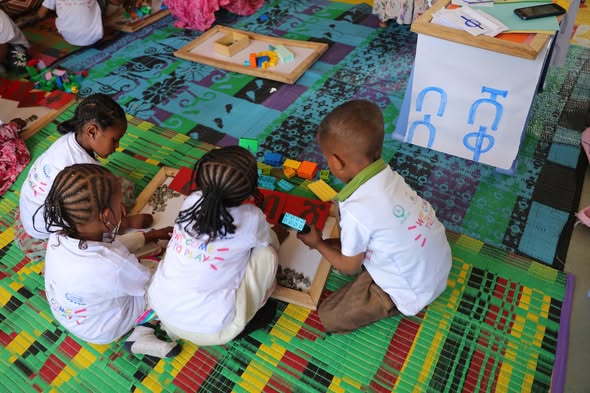
Play is the foundation of learning and it is the natural way for young children through which the brain develops and understanding is built. Play is learning , is not a break from learning.
First, play supports brain development. During play, children form millions of neural connections as they explore, imagine, move, and interact. These experiences strengthen the brain areas responsible for language, memory, attention, and emotional regulation. Scientists show that children learn best when they are actively engaged rather than passively instructed.
Second, play promotes holistic development. Through play, children develop cognitive skills (problem-solving, reasoning, creativity), social skills (sharing, cooperation, negotiation), emotional skills (self-control, confidence, resilience), and physical skills (coordination and motor development). A simple game can teach counting, communication, empathy, and persistence all at once.
Third, play encourages active and meaningful learning. When children play, they ask questions, test ideas, take risks, and learn from mistakes. This hands-on exploration helps them understand concepts deeply instead of memorizing facts. Learning becomes meaningful because it is connected to real experiences and interests.
Fourth, play builds language and communication skills. Pretend play, storytelling, songs, and group games help children learn new words, express ideas, and understand others. These early language experiences are critical for later reading, writing, and academic success.
Finally, play nurtures a love for learning. When learning is joyful and child-centered, children develop curiosity and motivation that last throughout life. Play creates positive attitudes toward school and learning, laying the foundation for lifelong learning.
Play is the foundation of learning because it shapes the brain, develops essential life skills, deepens understanding, and prepares children not just for school—but for life.
In early learning settings such as preschools, play-based learning can take many forms. Children may explore sensory materials like water tables or sandpits to discover textures and physical properties. They may also engage in imaginative play using dress-up clothes, pretend kitchens, or role-play scenarios, which help develop language, social interaction, and emotional understanding.
Play-based learning is child-initiated and teacher-supported. Children choose how, what, and how long they play, while educators guide learning by observing, encouraging, and extending children’s thinking. For example, when a child builds a structure with blocks, a teacher might ask open-ended questions such as:
- Can you tell me about what you’re building?
- Why did you choose these materials?
- What might you try next?
Through these interactions, play becomes a powerful pathway for developing critical thinking, creativity, and a strong foundation for lifelong learning.
Fundamentals of Play-Based Learning
For play-based learning to be effective, educators must intentionally incorporate its core elements.
1. Child-Directed and Self-Chosen
Children decide how to play, when to play, and for how long. While educators may offer materials or suggestions, children retain control over their choices. This autonomy allows children to explore their interests deeply—even in ways that may appear small or insignificant to adults.
2. Enjoyable and Meaningful
Enjoyment is essential. Play-based learning does not rely on predetermined outcomes or rigid objectives. For example, instead of instructing children to build a specific structure with blocks, educators simply provide the materials and allow creativity to unfold naturally.
3. Unstructured
Unstructured, or free play, is central to play-based learning. Children explore materials without fixed rules or expectations, allowing them to discover interests, test ideas, make mistakes, and learn without fear of failure.
4. Process-Oriented
The focus is on the learning journey rather than the final product. Children are not guided step-by-step on how to complete a task. This encourages deeper creativity, self-expression, and experimentation.
5. Imaginative
Imaginative and pretend play allow children to create stories, take on roles, and explore different perspectives. This form of play nurtures creativity, empathy, and social-emotional development.
Why Play-Based Learning?
Play-based learning supports holistic child development across multiple domains.
Language Development
During the preschool years, children rapidly expand their vocabulary. Play creates natural opportunities for meaningful conversations. In pretend play, for example, children ask questions, explain ideas, and negotiate roles. Educators can further support language growth by modeling new words, asking thoughtful questions, and participating in play.
Creativity and Imagination
Play encourages children to think creatively, explore possibilities, and solve problems. Pretend play often begins around age two and becomes increasingly complex as children grow, involving shared goals, roles, and storylines.
Social and Emotional Development
Through play, children learn to manage emotions, communicate needs, cooperate with peers, take turns, and resolve conflicts. These experiences build essential social skills and emotional resilience.
Positive Attitudes Toward Learning
When children choose their own activities, they are more motivated and engaged. Play-based learning builds confidence, persistence, curiosity, and a willingness to take appropriate risks—key traits for lifelong learning.
Motor Skill Development
Play strengthens both fine and gross motor skills. Activities such as drawing, painting, and building support hand coordination, while running, jumping, climbing, and dancing develop physical strength and balance.
The Stages of Play
Six stages of play are identified that reflect children’s social development from infancy through early childhood.
- Unoccupied Play
Typically observed from birth to three months, this stage involves spontaneous body movements that help infants develop sensory awareness and motor control. - Solitary Play
Common from three months to two years, children play independently and focus on their own activities. This stage supports self-discovery and problem-solving. - Onlooker Play
Around ages two to three, children observe others playing without joining in. Learning occurs through watching and listening. - Parallel Play
Children play side-by-side using similar materials but do not yet interact directly. This stage builds awareness of peers and social imitation. - Associative Play
Beginning around ages three to four, children start interacting, sharing materials, and talking during play, strengthening communication and social skills. - Cooperative Play
Typically emerging around ages four to five, children work together toward shared goals. Cooperative play fosters collaboration, negotiation, and teamwork.
What you should know about Play-Based Learning
Despite its many benefits, play-based learning can present challenges:
- Some children may prefer more structure and feel uncertain in open-ended environments.
- Families or educators may resist play-based approaches in favor of academic-focused, traditional instruction.
- Transitioning from a play-based program to a highly structured elementary setting can be challenging for some children.
Common play-based activities include:
- Water play to explore concepts like sinking and floating
- Dress-up and role play to build empathy and social skills
- Drawing and painting to support creativity and fine motor development
- Music, singing, and dancing to strengthen cognitive, social, and motor skills
- Pretend cooking and shopping to practice social interaction and basic math concepts
Play-based learning is a powerful approach that supports children’s cognitive, social, emotional, and physical development. By integrating play into education, children are encouraged to explore, create, and connect with the world in meaningful ways.
When children learn through play, they develop confidence, curiosity, resilience, and a genuine love of learning—qualities that prepare them not only for school, but for life in an ever-changing world.