Genetically Modified Maize as part of Field Trial
By Mekonnen Teshome
Simon Mengesha Chunora has been cultivating maize for over ten years on his plots in Sama Egersa village, Dore Bafano Woreda, Hawassa Area of the Sidama National State, Ethiopia.
However, despite his hard work and meticulous farming efforts to get the highly needed yields of the maize crops, he has always failed to harvest enough to feed his family and to get out of financial insecurity.
Simon says that Fall Army and Stem Borer worms are the two menaces of maize farming in his locality. “We cultivate maize as it is naturally a higher yield crop; however we usually loose half of the expected produces due to the devastating worms.”
Climate Change, Fall Army Worms [FAW] and Stem Borer Worms [SBW] are No More Difficult
Coupled with the harsh and ever growing climate change, Fall Army Worms [FAW] and Stem Borer Worms [SBW] as well as the worm inflicted maize fungus destroy the crop resulting in very low productivity and ultimately in food insecurity, according to Simon.
Various studies also corroborate Simon’s assertion and state that the estimated yield loss in maize production ranges from 11% to over 67% due to Fall Army and Stem Borer infestations.
The National Variety Release Committee (NVRC), after seven years meticulous scientific field trials and testing mainly in Ethiopia’s Great Rift Valley region, has approved the commercial of the Genetically Modified (GM) “TELA maize” variety in Ethiopia. The name TELA is derived from the Latin word tutela, which means “protection.”
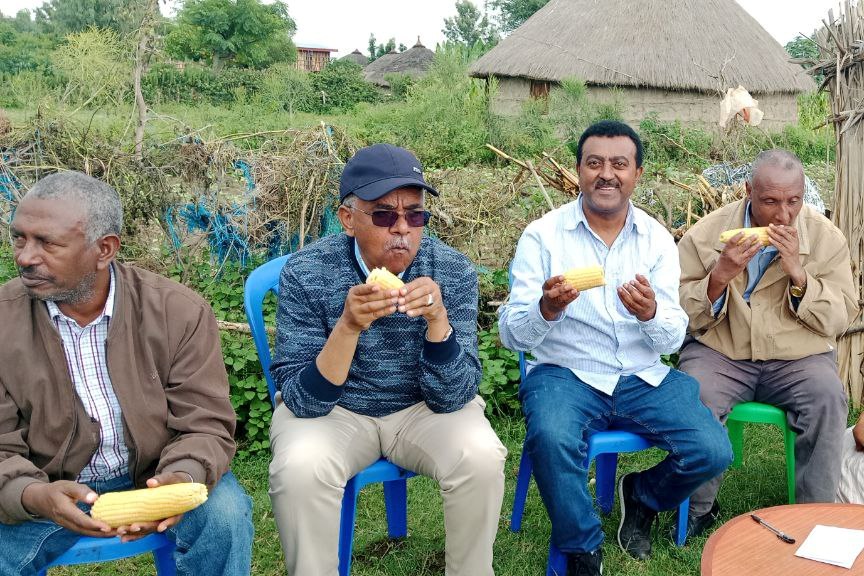
Regarding the effectiveness of the GM maize Simon, the farmer who volunteered to avail his plots for the scientific field trials, reiterated that the Bacterium Bacillus Thuringiensis (Bt) incorporated maize has demonstrated higher efficacy in contending insect pests / fall armyworm and stem borer/ as well as fungi accumulation in the various parts of the maize plant.
“The Bt maize is never attacked by worms and yields two threefold of produces. Moreover, as it leaves and stems have significant improvement in yield we are getting a good quality of animal fodder apart from our consumption of maize,” the farmer said.
Chemical Pesticides Are Causing Cancer, Not GM Maize
“We also don’t need any chemical to spray which is another financial relief for us. Farmers in our locality always bother due to the skyrocketing price of chemical pesticides to fight the disturbing worms and I really stopped to buy chemical pesticides because of its higher price.”
Studies indicate that a farmer has to spend up to 750 USD per hectare to cultivate conventional varies of maize.
The other maize framer who has provided plots for the GM maize field trial is Kassa Kayemo who is a resident in Bore Ejersa kebele, Dore Bafano Woreda, Hawassa Area of the Sidama National State, also expressed his pleasure with the effective technological solution he has got as part of the Bt maize project.
Kassa says that he has no more any concerns of Bt crop safety and effectiveness, but his worry is now only getting the GM Maize variety seeds so as to continue cultivating the crop and his pulling his family out of poverty by raising his financial income through the sales of maize.
For that matter, various studies indicate that there is a direct link between chemical pesticides exposure and cancer. A research finding published by the National Library of Medicine (NLM) “Cancer health effects of pesticides” states that many studies showed positive associations between pesticide exposure and solid tumours.
The most consistent associations were found for brain and prostate cancer, it underlines adding that an association was also found between kidney cancer in children and their parents’ exposure to pesticides at work.
In addition, experts indicate that chemical pesticides, if not administered in a proper time, would not be effective to curb especially stem borer worm once it enters the stem part of the plant.
However, no scientific experiment has proven that genetically modified crops caused cancers so far and significant portion of the world’s population has continued to grow and consume genetically modified foods both plants and animals.

Genetically Modified (GM Are Growing Worldwide
Briefing local journalists on the most recent data Lead Research and National Coordinator for the Open Forum on Agricultural Biotechnology in Ethiopia (OFAB-Eth) and Lead Researcher at the Ethiopian Institute of Agricultural Research (EIAR) Tadessa Daba (PhD) indicated that more than 18 million farmers in 29 countries, including 19 developing nations, planted over 190 million hectares (469.5 million acres) of GMO crops in 2019.
The genetically modified crops market size has grown strongly in recent years. It will grow from $23.88 billion in 2024 to $25.26 billion in 2025 at a compound annual growth rate (CAGR) of 5.7%. The growth in the historic period can be attributed to government initiatives for genetically modified food, emerging markets growth, growing demand for animal feed.
Five biotech crops planted in all these countries occupy 99% of the global biotech crop area, ISAAA reported in 2020. The five major biotech crops planted at more than 1 million hectares are soybeans (95.9 million hectares), followed by maize (58.9 million hectares), cotton (24.9 million hectares), canola (10.1 million hectares), and alfalfa (1.2 million hectares).
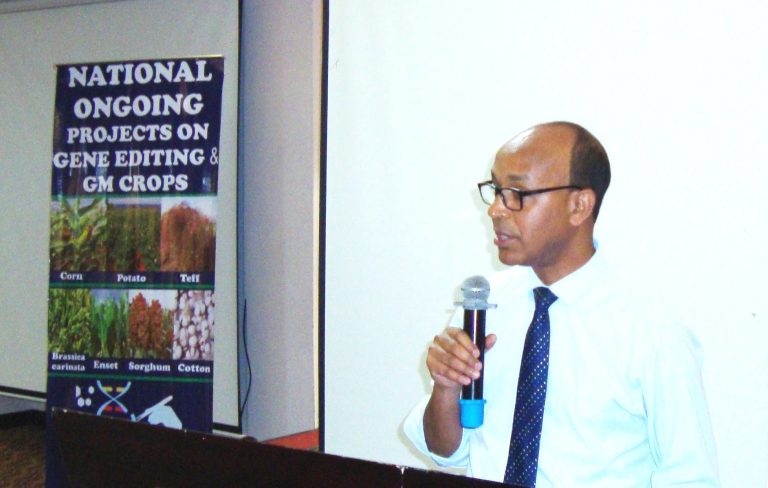
Chairman of the Ethiopian National Variety Release Committee (NVRC) Professor Firew Mekbib who was present at the field visit held in the Hawwassa area last weeksaid that the TELA maize research demonstration was organized to help journalists and the general public understands GM crops “that speaks for itself”.
According to Professor Firew, coordinated by the African Agricultural Technology Foundation (AATF), the TELA Maize Project, a public-private partnership, will involve national agricultural research systems in Ethiopia, Kenya, Mozambique, South Africa, Tanzania and Uganda and give sub-licenses to the qualified seed companies to combine the traited varieties with theirs to produce their own hybrids for sale.
The International Maize and Wheat Improvement Center (CIMMYT) – an internationally funded, non-profit, scientific 11 research, training, and development organization; and Bayer Crop Science (Bayer), a private agricultural company are also the other partners of the TELA project.
TELA Maize Hybrids Are Royalty-Free, Not Supplied By Multinational Corporates
As the TELA Maize hybrids are royalty-free, respective local research institutions that developed the seeds under national governments will own the maize varieties and therefore, multinational corporates would never control and limit farmer choice and increase costs as well as cannot undermine the diversity of traditional and native crop varieties.
“For that matter, we Ethiopians have resorted to plant the Genetically Modified Maize by ourselves. It’s our choice and determination because our farmers deserve best technologies including Bt Maize,” Professor Firew underlined.
“There is no one in the world that can choose what should plant or not plant. We don’t have ‘Colonial Masters’ or a multinational corporate group that can impose its interests on us.”
“We have proven that the TELA Bt Maize variety has worked in our ecology and we know that it is very safe and economically advantageous. We cannot deprive our poor and hardworking farmers this amazing variety of maize that would undoubtedly revolutionize maize farming in Ethiopia,” he added.
Concerning the government country and safety measures, the Professor asserted that the biosafety procedures for Bt maize are governed by the Environmental Protection Authority (EPA). The research process also aligns with the Cartagena Protocol related to risk assessment, public participation, and post-harvest monitoring.
The National Variety Release Committee also approved the commercialization of TELA Bt maize this year with a framework in place for the controlled and safer management of the genetically modified crop, Professor Firew added.
Now the Question is not the Safety, Rather Access to the GM Maize Seeds, Supportive Regulatory Framework
As the GM maize research culminates in an extremely successfully tests and government approval of its commercialization, Tesfaye Disasa (PhD), the TELA Maize project country coordinator at the Ethiopian Institute of Agricultural Research (EIAR), apparently forwarded his concerns for policy makers including speedy seed development of the Bt maize variety, in the face of the country’s well established maize seed research systems, as well as amendments of the stringent and prohibitive Bt crop cultivation rules in the guideline of the Environmental Protection Authority (EPA).
These include what they call “the principles of Zonation, Reproductive Isolation and Refugia System” which are totally not proper and odd never happened somewhere else in the world.
The larvae of Fall Army Worm, which is native to the Americas, causes extensive damage to maize plants by consuming leaves, often leaving behind characteristic “window pane” damage and droppings. The adult moths are strong fliers, allowing them to spread rapidly and making eradication impossible once established in a new region.
Maize stem borer is identified by its yellowish-brown larva with a brown head, and as it matures, it turns into straw-colored moths. The damage begins with the young larva feeding on tender, folded leaves, leading to a “shot hole” appearance. As the larvae grow older, they bore into the stem, feeding on internal tissues, resulting in bore holes, tunneling, and eventually causing the central shoot to dry up.