As the Ethiopian Institute of Agricultural Research (EIAR) undertakes field performance trials of Genetically Modified (GM) maize at its various agricultural research sites, the maize verities have demonstrated effective resistance to the devastating “Fall Armyworm”.
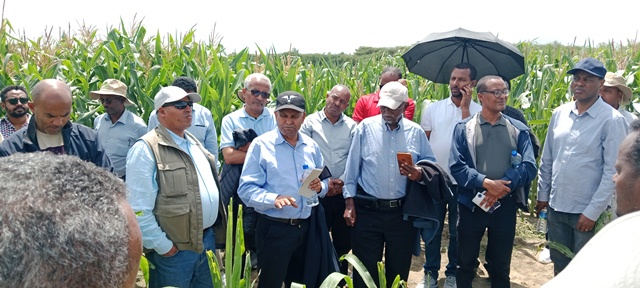
This was witnessed during a field trial visit by Ethiopian top scientists including from the Ethiopian Academy of Sciences (EAS) to the TELA maize demonstration plots of the Dhera site of EIAR’s Melkassa Agricultural Research Center on Saturday, October 11, 2025.
The field demonstration which was jointly organized by the Biotech Maize Seed System (BMSS), the Ethiopian Society of Biotechnology (ESoB), and the Biotechnology and Emerging Technologies Institute (BETin), featured three maize varieties—MH142B, MH141 and MH140—planted on 10×10 meters plots and exposed to natural fall armyworm infestation.
During the visit the scientists witnessed that the MH142B variety has exhibited clear resistance to fall armyworm without requiring pesticide applications, while MH141 and MH140 needed 2–3 rounds of agrochemical sprays. Participants described MH142B’s performance as a tangible advantage for pest control under the local conditions.
The TELA Maize Project is a public-private partnership led by the African Agricultural Technology Foundation (AATF) working towards the commercialization of transgenic drought-tolerant and insect-protected (TELA) maize varieties to enhance food security in sub-Saharan Africa, according to AATF.
“Launched in 2018, the TELA Maize Project builds on progress made from a decade of breeding work under the Water Efficient Maize for Africa (WEMA) Project.”
Prof. Firew Mekbib, President of Ethiopian Society of Biotechnology (ESoB) and coordinator of the event, at the occasion reaffirmed his society’s commitment in promoting and advancing evidence-based decision-making. “This product has been tested under our conditions and approved to be cultivated by our farmers,” he stated. According to Professor Firew, while the research is supported by the Bill & Melinda Gates Foundation (BMGF) through the African Agricultural Technology Foundation (AATF), the decision to adopt or not to adopt remains at Ethiopia’s own right.
The TELA maize initiative aims at protecting maize against drought and pest infestations and ultimately to contribute to the enhancement of crop yields and support smallholder farmers across Ethiopia. The scientists also emphasized that seed access, farmer training on stewardship and integrated pest management, and continued biosafety monitoring are essential for responsible and equitable adoption.
Representatives from the Ethiopian Institute of Agricultural Research (EIAR), BETin, and OFAB node coordinators from Jimma, Haramaya and Addis Ababa universities participated in the field visit program. Organizers noted that the field demonstration complemented earlier national dialogues and trials that have drawn public and scientific attention to the promise and challenges of GM TELA maize in Ethiopia.
A member of the Ethiopian Academy of Sciences and a renowned sorghum breeder Dr. Berhane Gebrekidan has commended the application of biotechnology in addressing agricultural challenges. He highlighted the importance of applying scientific advancements to advance food security and productivity in Ethiopia.
Deputy Director General of BETin Dr. Hailu Dadi also on his part underlined that the release of TELA maize showcases how science is a powerful tool to bring about change and development. “We cannot escape from the growth of science; we must embrace and use it to our advantage, or risk falling behind.” He finally called for stronger collaboration among stakeholders in applying high-end technologies including gene editing for the improvement of crops and agricultural productivity.
Dr. Tesfaye Disasa, BMSS Project Coordinator at EIAR, welcomed participants and explained that the project was initiated to address farmers’ challenges with fall armyworm, especially during drought conditions in areas like Dera.
He noted that TELA varieties have exceeded the minimum performance standards required for registration in Ethiopia. However, he expressed concern over negative attitudes from anti-technology groups, which have prolonged the deregulation process from 150 to over 900 days—delaying farmers’ access to the seed. “While some criticisms are tolerable, the impact on regulatory delays is unacceptable,” he said.
Also at the occasion, Derese Teshome, Outreach and Advocacy Team Lead for the project, noted that the existence of the product has helped create awareness more effectively than previous promotional efforts. He stressed the importance of organizing “seeing is believing” events to engage various segments of the community and foster constructive dialogue.