– “Whole-Genome Sequencing” Training Aims At Strengthening Infectious Diseases Surveillance
Addis Ababa (April 16, 2024): The International Centre For Genetic Engineering and Biotechnology (ICGEB), as part of its “BIOTECHNET – Enhancing biotechnology know-how in the Horn of Africa” project, is partnering with the Ethiopian Bio and Emerging Technology Institute (BETin) in an effort to build the capacity of biotechnology experts in the eastern African nation.
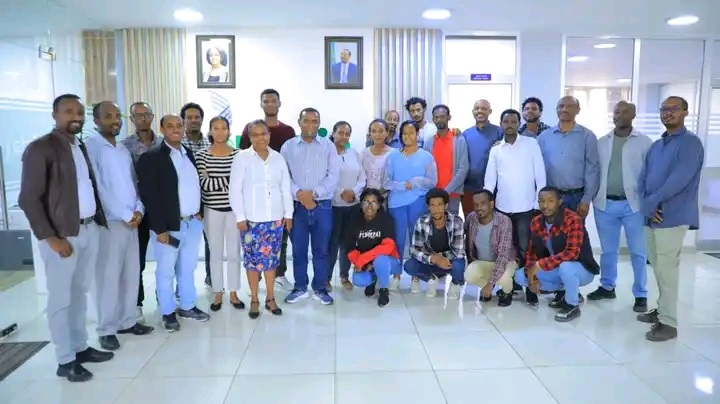
In a latest joint initiative, ICGEB and BETin offered a training for over 40 biotech experts drawn from Ethiopian universities, federal and regional states research institutions, BETin states today in its social media outlets.
According to the institute, the training workshop, attended by the participants both in person and virtually, aims at strengthening the capacity of the attendees in applying Whole Genome Sequencing for effective management and control of emerging infectious disease outbreaks.
Part of Virtual Training Facility (VTF) of ICGEB and BETin
The training workshop that went April 8 to 12, 2024 and themed “Applications of Whole-Genome Sequencing for Infectious Diseases Surveillance”, as to the institute, is part of the ongoing project – Implementation of a Virtual Training Facility (VTF) – of the Bio and Emerging Technology Institute, co-funded by BETin and ICGEB-BiotechNet.

Opening the training workshop, BETin Director General Dr. Kassahun Tesfaye said that apart from its research and development activities in the areas of bio and emerging technologies, his institute has carried out short-term bioinformatics capacity-building activities in collaboration with ICGEB-BiotechNet project to advance biotechnology researches in Ethiopia.
The Director General pointed out that besides the vital contribution of this training in enhancing the local capacity to use state-of-the-art technologies and tools to implement effective outbreak control strategies, it also offers an opportunity for networking and future collaboration among the participants.
Dr. Zewdu Edea, Director of the Genomics and Bioinformatics Directorate and Manager of the VTF, on his part highlighted the key challenges, impacts, and threats of emerging infectious diseases, as well as the potential applications of genomics and bioinformatics tools for monitoring, early detection, and effective management of emerging infectious disease outbreaks.
The training was provided by experienced researchers and bioinformaticians from BETin, ICGEB, Addis Ababa University, and the Armauer Hansen Research Institute (AHRI). Topics covered by the training include: the basics of sequencing technologies, genomic epidemiology, hands-on practice with whole-genome data analysis, sequence data retrieval and submission, phylogenetic tree construction, and clade assignment.

Dr. Hailu Dadi, Deputy Director General of BETin, while speaking at the closing event also underscored that BETin has supported several graduate and postgraduate students, and researchers in omics and biological data analysis.
The Deputy Director General indicated that this kind of training would play an important role in bridging the existing gaps in whole-genome data analysis (bioinformatics) and data mining.
He also extends his thanks to all the attendees for their active participation and assured them that BETin will continue organizing and providing demand-driven short-term capacity-building training to support and advance biotechnology/omics research and development activities.
According to experts, Whole Genome Sequencing is a laboratory procedure that determines the order of bases in the genome of an organism in one process. All organisms (bacteria, vegetable, mammal) have a unique genetic code, or genome, that is composed of nucleotide bases (A, T, C, and G). Knowing the sequence of the bases in an organism, is key to identify its unique DNA fingerprint, or pattern. Determining the order of bases is called sequencing.
ICGEB Committed To Support Global Biotech Initiatives
The International Centre For Genetic Engineering And Biotechnology (ICGEB) is a unique, autonomous, Intergovernmental Organisation, with biotech labs in Italy, India, and South Africa.
Bio and Emerging Technology Institute (BETin), the formerly Ethiopian Biotechnology Institute (EBTi), is also one of the affiliated institutes of the Ethiopian Ministry of Innovation and Technology (MiNT). Its mandates include supporting, organizing, and directing the various biotech research works conducted separately in different universities and research institutes.
BETin also strives to resolve and address the major challenges in society that are related to health, food security, the realization of sustainable development and facilitate the basement of industrialization, work on human development and to establish the general framework and basic structures for national innovative research.