By Teshome Mekonnen
Malawi quest to introduce the first genetically modified food crop has taken off to a flying start following excellent performance of the first Bt Maize Confined Field Trial (CFTs) planted on December 26, 2023.
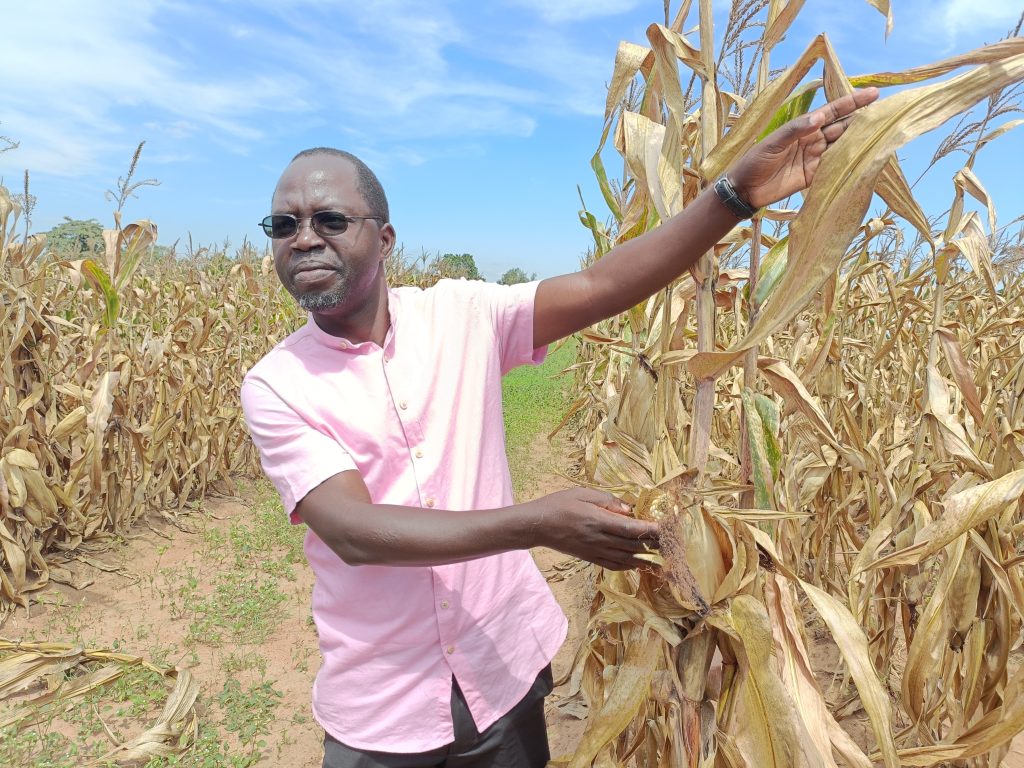
Bt Maize confined field trials
“We were testing against insect resistance to Fall armyworm. Whereas the Bt maize variety withstood the insect, the ordinary maize which does not have the Bt gene was eaten up by the insects,” said Dr Abel Sefasi, a molecular biologist who is the chief scientist in the project.
The confined field trials are being undertaken by a team of experienced scientists who includes Dr Trust Donga the entomologist in the project and Prof James Bokosi who is the project advisor. They all teach at Malawi’s Lilongwe University of Agriculture and Natural Resources (LUANAR).
According to Dr Donga and Prof Bokosi the crop had done very well under the conditions making them believe that the trials, expected to end after three seasons, will prove their efficacy.
While speaking to the Seed Trade Association of Malawi (STAM) Biotech and Innovation Committee who made a seeing is believing tour of the site at the university’s Bunda College campus last week, the scientists noted that the varieties have shown that they can withstand Fall armyworm.
The Committee, led by STAM Secretary General, Nessimu Nyama said the cobs looked fine and expressed hope that Malawi will soon benefit from the researchers’ work. The committee works in partnership with the African Seed Trade Association’s (AFSTA) Plant Biotechnology Project.
“Looking at the performance of the Bt crop now at these confined trials, we can clearly see that those that were treated with traits of tolerance have done better than the untreated maize. Farmers in Malawi will benefit as they will have seeds that tolerate insect pests such as Fall armyworm,” said Nyama.
According to Dr Sefasi, it will take another three seasons for the scientists to introduce the BT crop into for multi-locational trials across the country. This will only happen if the National Biosafety Authority of Malawi approves the trials as successful based on their safety and ability to withstand the Fall armyworm.
The approval by the NBA will be followed by checking the crop performance in the different agro-ecologies of the country. The expected time for this crop to be in the market may be well after 2028.

Should the BT maize be approved in the country, it will be the second genetically modified crop to have been licensed in the Southern Africa country. About four years ago, the country approved the commercialization of Bt cotton which has since been taken up by thousands of farmers in Malawi. About 94% of the land in Malawi is currently planted with the Bt cotton.
Experts point out that the GM crop will help bridge the gap the country experiences annually in maize production. Currently maize production is estimated at a below‑average level of 3.5 million tonnes in 2023. The low maize outturn primarily reflects a downturn in yields, and secondarily localized crop losses and damage in southern districts due to flooding caused by the passing of Cyclone Freddy in March last year.
Ethiopia is ready for TELA Bt maize variety release
In Ethiopia, Bt cotton is out in the field as a fully commercial crop. TELA maize has also completed all regulatory stages and should be ready for variety release. At the same time, scientists say that work is progressing well on late blight resistant potato.
Genetically modified organisms or GMOs has become the common term consumers and popular media use to describe foods that have been created through genetic engineering. Genetic engineering is a process that involves identifying the genetic information—or “gene”—that gives an organism (plant, animal, or microorganism) a desired trait; copying that information from the organism that has the trait; inserting that information into the DNA of another organism and then growing the new organism.