Passport
Ethiopian passport has fallen four places to 93 in global ranking since July last year
The Ethiopian passport has fallen in global ranking since July last year and international travel has become tougher for citizens, the Henley Passport Index Report indicated.
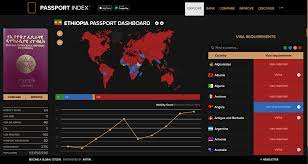
The Passport Index Report released on Wednesday shows the Ethiopia passport fell four places, from 89th in July 2023 to 93rd place in January 2024, due to the conflicts in the country.
Holders of Kenya’s passport can travel to 76 countries without prior visa application, 47 countries for Ethiopians, 69 for Ugandans, and 73 for Tanzanians, the report stated.
“Ethiopia has been rocked by violent internal conflict, involving militia groups from the regions of Amhara and Oromia and between the central government and those in the northernmost region of Tigray, then under the control of the Tigrayan People’s Liberation Front (TPLF).”
According to the report, in late 2023, the central government escalated its military operations in Amhara, while its peace talks with the largest Oromo militia collapsed for the third time.
“These increased conflicts have seen the passport’s index fall in the global mobility ranking. Visa-free travel opens up possibilities for easy movement, potentially boosting opportunities for tourism and business.”
Dr Yossi Harpaz, an associate professor of sociology at Tel Aviv University, said in the report that the citizens of unstable, poorly developed, and autocratic countries have low travel freedom.
This is because countries typically vet them before admission out of concern about unwanted immigration.
At the beginning of August last year, Ethiopia declared a six-month regional state of emergency, and residents reported hearing heavy gunfire and seeing military aircraft.
The wars have led to hospitals, schools, factories, and businesses being shelled, looted and destroyed by Ethiopian federal forces regional militias, and by Eritrean armed forces.
This has restricted the movement of tourists and humanitarian access forcing millions of people to flee their homes to neighbouring countries like Sudan.
Sudan’s passport fell from 92nd in July 2023 to 95th place with access to 45 visa-free countries, while South Sudan’s moved from 90th to 94th with 46 visa-free entry nations.
The Henley Openness Index ranks all 199 countries and territories worldwide according to the number of destinations their holders can access without a prior visa using data from the International Air Transport Association (Iata).
East African passports among weakest worldwide
The Ugandan passport dropped one place from a global ranking of 72nd place to 73rd in the same period under review, while Kenya, Tanzania and Rwanda did not move places at 67th, 69th and 76th respectively.
While Rwanda’s ranking did not change, the number of countries its passport holders can travel visa-free rose from 63 to 66.
France, Germany, Italy, Japan, Singapore and Spain were ranked the World’s most powerful passports.
Mauritius which has maintained its top position on the continent, fell one rank down from 30th to 29th passport, showing that holders can visit 148 countries visa-free.
South Africa’s passport also fell two pegs from 51st place globally in July to 53rd.
Lesotho dropped from 64th to 65th, Namibia from 62nd to 65th place and Malawi from 68th to 67th place.
The African Union estimates that about 70,000 skilled professionals emigrate from Africa every year. Currently, Africa is the world’s youngest continent, with an estimated 10 to 12 million young Africans joining the labour force each year.
Yet the continent is able to create only about 3 million jobs annually. With limited economic opportunities, many young Africans are migrating to Europe and America for economic opportunities.
In 2016, the IMF’s World Economic Outlook reported a growing number of African migrants in OECD countries. Estimated at 7 million in 2013, the total number of African migrants in OECD countries could rise to 34 million by 2050.
In 2013, France, the United Kingdom (UK), and the United States (US) hosted about 50.0% of the total sub-Saharan African diaspora.
Africa’s Island countries are most impacted by this phenomenon, with almost one-third of Cabo Verde’s population and about 10.0% of Mauritius, São Tomé & Príncipe, and Seychelles’ population living outside the country.