
By Mekonnen Teshome (Science Writer)
Conference Themed – “Research Ethics in Ethiopia : The Past and the Future”
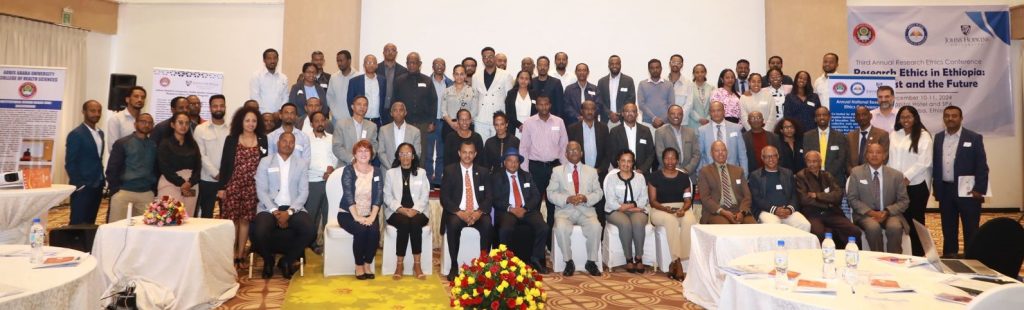
Addis Ababa, Ethiopia: Ethiopian scholars who are attending the third Annual Research Ethics Conference of the Johns Hopkins University-Addis Ababa University Research Ethics Training Program (JHU-AAU RETP) , December 10-11, 2024, have emphasized the vital role of research ethical principles in ensuring authenticity and credibility.

While delivering his opening speech at the conference themed “Research Ethics in Ethiopia : The Past and the Future”, Professor Andualem Deneke ECD of the School of Health Sciences of the Addis Ababa University, yesterday, December 10, 2024, underlined that the proper application of research ethics is imperative to ensure and protect the rights of research participants.
According to Professor Andualem, research ethics help researchers to conducted authentic and error-free researches in an objective, honest and transparent manner and ultimately to help societies benefit from research products.
Professor Andualem who elaborated on major principles of international instruments of research ethics including the “Declaration of Helsinki”, said that the the research community needs to abide by international ethical principles in medical researchers to protect and reinforce the rights and interests of human participants in general and vulnerable groups of the society – children, women, refugees, in particular.

Prof. Afework Kassu, Director General of the Armauer Hansen Research Institute (AHRI) on his part said that research ethics is essential not only to protect the rights, dignity, and welfare of research participants but also to help the science itself be trustworthy and reliable.
Prof. Afework , who is a prominent researcher of epidemiology, immunology, and molecular biology of infectious diseases himself, called on researchers in Ethiopia to consider highest standards of research ethics in their effort to analyze and understand the natural and biological world by involving human subjects.
The head of JHU-AAU RETP Dr. Adamu Addissie also indicated that the joint research ethics training program has been instrumental in creating a path for research ethics within the Addis Ababa university through the Public Health Masters program and basic and advanced ethics workshops in collaboration with the Johns Hopkins University and other partners.

The Johns Hopkins University-Addis Ababa University Research Ethics Training Program aims at promoting a robust culture of health research ethics and adherence to ethical principles., providing research ethics-related training pro- grams for stakeholders, and advocating for the responsible conduct of re- search, he pointed out.
Moreover, the program focuses in collaborating with the National Research Ethics Review Board, conducting research and case studies to generate evidence for policy advocacy and explore cultural nuances in ethics as well as supporting the establishment of Institutional Review Boards (IRBs) at all academic institutions through advocacy and training and organizing an annual research ethics conference in partnership with stakeholders, he added.
As to Dr. Adamu, the Health Research Ethics Specialty Track within the Master of Public Health (MPH) program at AAU, School of Public Health (a first for the country) recruited and trained a total of 26 Master’s trainees within three cohort (exceeding our target of 15 trainees) and six trainees a as cohort four are currently on training.
Four more cohorts of Master’s students trained in health research ethics From 2025-2030

“ From 2025-30, we plan to train four more cohorts of Ethiopian Master’s students be trained in health research ethics. We will lever- age the very close collaboration between our two institutions, as well as JHU’s 25 years of ef- forts to strengthen research ethics capacity in Africa through Fogarty bioethics programs, to continue to transform the Ethiopian research ethics landscape.”
Dr. Joseph Ali , Associate Professor at Johns Hopkins University, Berman Institute of Bioethics and Bloomberg School of Public Health, Co-director of the JHU-AAU RETP said that the partnership between his university and the Addis Ababa University focuses on investing in the future of Ethiopian ethicists and assisting in building the research ethics capacity of scholars in the academia.

The program aims at promoting dialogue on research ethics among policy makers and various professionals in Ethiopia and the partnership will establish a Research Ethics Unit within an existing center for ethics at AAU, Dr. Joseph added.
The Addis Ababa University-Johns Hopkins University Research Ethics Training Program (AAU-JHU RETP) is a collaborative program embraces a “systems” approach to capacity strengthening; placing an emphasis on ad- dressing individual, institutional and nation- al research ethics needs to produce an eco- system supportive of high quality, ethical re- search.